

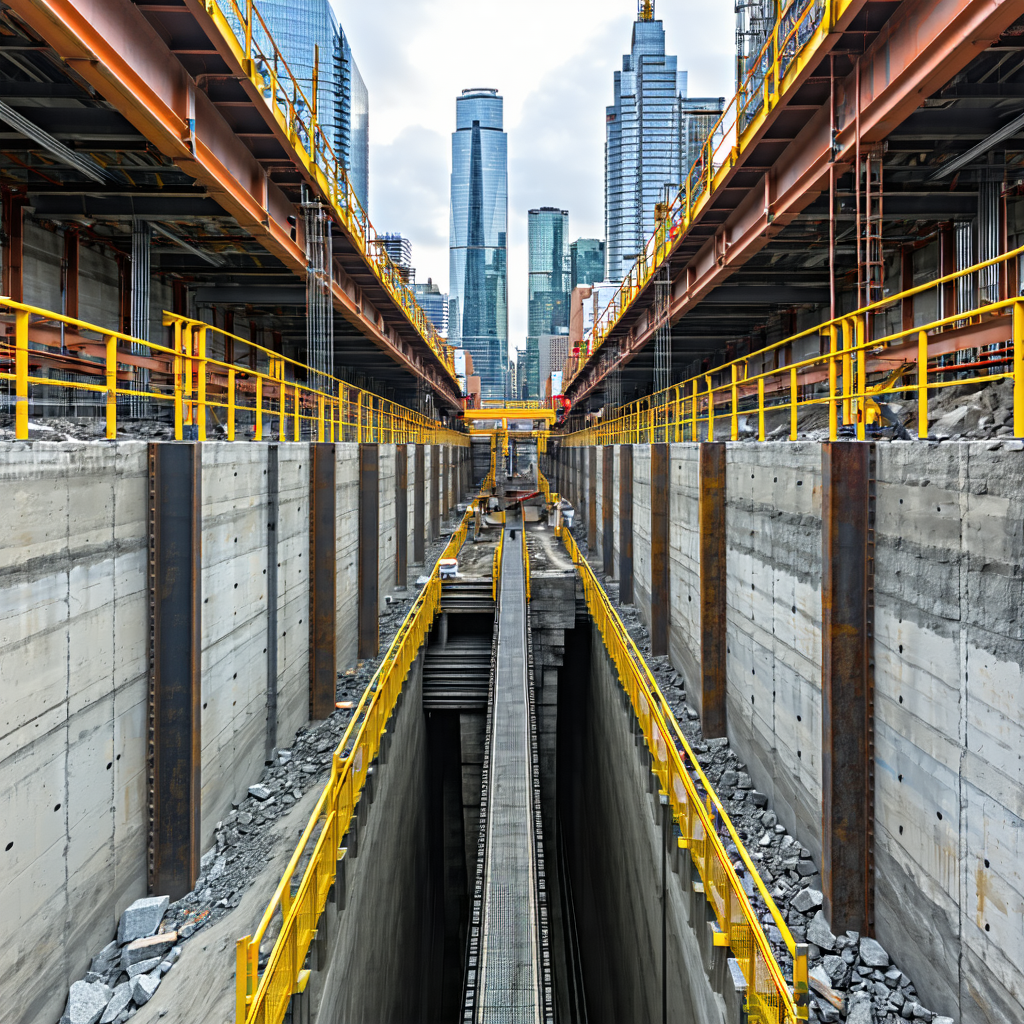
Internal bracing systems, specifically high-stiffness rakers and struts, represent a critical engineering response to the dense urban constraints found throughout the Greater Toronto Area. In many prime development corridors, traditional tieback systems are precluded by a variety of factors: proximity to existing subway tunnels, encroachment on adjacent private property rights, or the presence of high-density utility clusters that cannot be disturbed. In these scenarios, the structural integrity of the excavation relies entirely on internal members that transfer lateral earth pressures back into the central foundation or across the excavation span itself.
The design of a raker system begins with the installation of a central heel block, typically a massive reinforced concrete footing designed to resist the significant thrust loads from the raker beams. The rakers themselves are heavy-gauge steel H-piles or wide-flange sections that incline from the shoring wall down to the heel block. Because rakers occupy precious space within the excavation footprint, technical sequencing is paramount. The internal bracing must be installed at specific vertical intervals as the excavation descends to ensure the shoring wall never exceeds its unbraced length capacity. This method requires meticulous coordination with the foundation crew, as the raker positions must be integrated into the final slab and column layout to minimize structural interference.
Cross-lot strutting is a secondary internal bracing strategy utilized in narrower excavations or pits where symmetrical support can be achieved. These horizontal members span the entire width of the excavation, essentially propping one shoring wall against the opposite one. High-stiffness struts are often pre-loaded using hydraulic jacks to minimize the movement of the wall during the transfer of load. By applying a pre-stress that matches or slightly exceeds the expected active earth pressure, engineers can virtually eliminate the ‘kick-out’ or deflection that typically occurs in deep GTA soils like glacial till or silt. This level of precision is essential when working adjacent to sensitive heritage structures or vibration-sensitive infrastructure.
Thermal effects on long steel struts must also be considered in the Toronto climate. Significant temperature fluctuations can lead to expansion or contraction of the steel members, which in turn alters the load applied to the shoring walls. Engineers account for this by incorporating thermal load factors into the structural model and, in some cases, using monitoring systems such as strain gauges to provide real-time data on the bracing performance. This data-driven approach ensures that the internal bracing remains within its elastic limit throughout the duration of the project, from initial dig to the completion of the permanent structural frame.
Ultimately, the selection between rakers, struts, or a hybrid internal system depends on the ‘pit’ geometry and the logistical constraints of the site. While internal bracing increases the complexity of the excavation and foundation pour, it provides a fail-safe solution for urban intensification projects where external anchors are not an option. Aden Earthworks specializes in the technical execution of these complex shoring supports, ensuring that every deep excavation in the GTA is managed with the highest standards of lateral stability and structural safety.

